The first trimester — the first 13 weeks of pregnancy — is perhaps the most transformative period in your baby’s entire development. In just a matter of weeks, a cluster of cells becomes a recognizable human form with a beating heart, developing limbs, and a forming brain. It is also the period when your body is adjusting to one of the biggest changes it will ever experience.
During these early weeks, ultrasound scans are your window into what is happening inside. They confirm that your pregnancy is healthy, track how your baby is growing, and screen for any conditions that need early attention. But with multiple scans recommended in the first trimester, it can feel overwhelming to know which scan is needed, when, and why.
This guide breaks it all down — clearly, simply, and reassuringly.
Why Are First Trimester Scans So Important?
The first trimester is a period of rapid and critical development. Most major organs and body systems begin forming during these weeks — which also means that if something is going to go wrong, it often shows up early. First trimester scans serve several vital purposes:
They confirm that the pregnancy is healthy and developing inside the uterus. They establish an accurate due date, which guides every scan, test, and milestone that follows. They detect chromosomal conditions and structural abnormalities at the earliest possible stage. They provide reassurance to parents during an emotionally charged and often anxious time.
Missing or delaying these scans — particularly the NT scan — can mean losing a critical, time-sensitive window for screening. Early detection always leads to more options, more time, and better outcomes.
What Scans Are Done in the First Trimester?
There are two primary ultrasound scans performed during the first trimester, each at a specific stage and for a specific purpose.
Scan 1 — The Viability Scan (6 to 10 Weeks)
The viability scan is your very first pregnancy ultrasound. It is typically recommended between 6 and 10 weeks of pregnancy — usually soon after a positive pregnancy test, especially if you have any early concerns.
What does the Viability Scan confirm?
The name says it all — this scan confirms that your pregnancy is viable, meaning it is developing in the right place and in the right way.
At this stage, the scan checks whether the pregnancy is located inside the uterus, ruling out an ectopic pregnancy — a condition where the embryo implants in the fallopian tube or elsewhere, which can be life-threatening if undetected. It detects the fetal heartbeat, which is usually visible from around 6 to 6.5 weeks. It identifies the number of embryos — whether you are expecting one baby, twins, or more. It measures the Crown-Rump Length (CRL) to calculate your accurate gestational age and expected due date. It also assesses the health of the gestational sac and surrounding structures.
Who especially needs a Viability Scan?
While it is recommended for all pregnant women, the viability scan is particularly important if you have experienced a previous miscarriage or pregnancy loss, have conceived through IVF or assisted reproduction, are experiencing early spotting or cramping, have irregular cycles that make due date calculation difficult, or have a history of ectopic pregnancy.
Even if you feel perfectly well, this scan offers something invaluable — the peace of mind that comes from hearing your baby’s heartbeat for the very first time.
Scan 2 — The NT Scan / Combined First Trimester Screen (11 to 13 Weeks 6 Days)
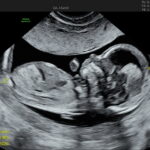
The NT Scan — short for Nuchal Translucency Scan — is the most important screening scan of the first trimester. It must be performed within a very specific window: between 11 weeks and 13 weeks 6 days of pregnancy. Outside this window, the scan cannot be interpreted accurately, making timing absolutely critical.
What does the NT Scan measure?
The scan measures the nuchal translucency — a fluid-filled space at the back of the baby’s neck. In healthy pregnancies, this space is small. When it is larger than expected, it can indicate a higher likelihood of chromosomal conditions such as Down’s syndrome (Trisomy 21), Edwards’ syndrome (Trisomy 18), or Patau’s syndrome (Trisomy 13). It can also be an early indicator of certain heart defects.
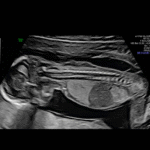
Along with the nuchal fold measurement, the NT scan also checks the presence of the nasal bone — its absence at this stage is a known soft marker for Down’s syndrome. The scan gives an early structural overview of the baby, including the developing brain, heart, spine, limbs, and abdominal wall. The fetal heart rate is also assessed, as abnormalities here can sometimes point to cardiac concerns.
The Combined First Trimester Screen (CFTS)
The NT scan is most powerful when combined with a maternal blood test, which measures two key hormones — PAPP-A (Pregnancy-Associated Plasma Protein-A) and free beta-hCG. Together, the ultrasound findings and blood test results generate a personalized risk score for chromosomal conditions. This combined approach — known as the Combined First Trimester Screen — is significantly more accurate than either the scan or blood test alone.
It is important to understand that this is a screening test, not a diagnostic test. A higher-risk result does not confirm a condition — it means further diagnostic testing such as NIPT (Non-Invasive Prenatal Testing), CVS (Chorionic Villus Sampling), or amniocentesis may be recommended for a definitive answer.
Who especially needs an NT Scan?
The NT scan is recommended for all pregnant women as a standard part of prenatal care. It is particularly important for women above the age of 35, those with a personal or family history of chromosomal conditions, pregnancies conceived through IVF, those who had an abnormal viability scan finding, or those who have had a previously affected pregnancy.
Week-by-Week: What to Expect in the First Trimester
Understanding when each scan fits into your pregnancy timeline helps you plan and prepare with confidence.
| Week | Milestone | Scan / Test |
|---|---|---|
| Week 4–5 | Positive pregnancy test | Consult your doctor |
| Week 6–7 | Embryo implanted, heart forming | Viability Scan (heartbeat check) |
| Week 8–10 | Major organs beginning to form | Viability scan (if not done earlier) |
| Week 11–12 | Baby fully formed in miniature | NT Scan + Blood Test (CFTS) |
| Week 13 | End of first trimester | Final window for NT scan |
What Happens After the First Trimester Scans?
Once your first trimester scans are complete, your doctor will review the findings and guide your next steps.
If all findings are normal, you will be reassured and guided toward your second trimester care plan, including the mid-trimester anomaly scan typically scheduled between 18 and 20 weeks.
If the NT scan or blood test results indicate an elevated risk, your doctor will explain what this means in detail and discuss further testing options. Having a higher-risk result can feel frightening, but it is important to remember that it opens the door to more information — not a final verdict. Many pregnancies with elevated screening results go on to be completely healthy.
At NESA Institute of Fetal Medicine, no patient leaves a scan with unanswered questions. Every result is explained clearly, compassionately, and in language you can understand.
Common Questions About First Trimester Scans
Q: Are first trimester scans safe for the baby? Yes, completely. Ultrasound scans use sound waves — not radiation. They have been used safely in pregnancy for decades and pose no known risk to the mother or baby.
Q: How is the scan performed — over the stomach or internally? In early pregnancy (especially before 8–9 weeks), a transvaginal scan (internal) often provides clearer images because the uterus is still very low in the pelvis. As pregnancy progresses, a transabdominal scan (over the belly) becomes more effective. Your sonographer will choose the most appropriate method based on your stage of pregnancy and comfort.
Q: What should I do to prepare for my first trimester scan? For a transabdominal scan, a partially full bladder helps improve image quality — drink about 2–3 glasses of water an hour before. For a transvaginal scan, an empty bladder is preferred. Your doctor or the NESA team will advise you specifically when you book your appointment.
Q: What if I miss the NT scan window? If you are beyond 13 weeks 6 days, the NT scan can no longer be performed. In this case, your doctor may recommend second trimester screening alternatives such as the Quadruple Test or a detailed anomaly scan. This is why booking your NT scan on time — ideally as soon as you complete 11 weeks — is so important.
Q: My viability scan showed twins. Does that change anything for the NT scan? Yes. Twin pregnancies require more detailed assessment during the NT scan, including evaluation of the type of twins (identical or fraternal, and whether they share a placenta). At NESA, our fetal medicine specialists are experienced in managing multiple pregnancies and will ensure both babies are assessed thoroughly.
Q: What if the viability scan doesn’t detect a heartbeat? This can happen for two reasons — either the pregnancy is earlier than expected and the heartbeat simply isn’t visible yet, or there is a concern about the pregnancy’s viability. Your doctor will advise a repeat scan within 7–10 days before drawing any conclusions. This is a moment where having a compassionate, experienced team around you makes all the difference.
Why First Trimester Scans at NESA Are Different
At NESA Institute of Fetal Medicine, first trimester scans are performed by trained fetal medicine specialists — not general radiologists. This distinction matters enormously, especially for the NT scan, where the accuracy of measurements depends directly on the skill and experience of the sonographer.
Every scan at NESA uses advanced GE Voluson ultrasound technology, which delivers exceptional image clarity — critical for detecting fine details like nuchal fold thickness and nasal bone presence. Our specialists are trained in the Fetal Medicine Foundation (FMF) protocols, ensuring that your screening results meet international standards of accuracy.
But beyond technology, what sets NESA apart is the human approach. You are never rushed. Your concerns are never dismissed. Every scan ends with a clear explanation of what was seen — and what comes next.
A Note for First-Time Mothers
If this is your first pregnancy, the first trimester can feel like a whirlwind. Between the physical changes, the emotions, and the flood of information, it is easy to feel overwhelmed.
Here is what matters most: book your viability scan early, and don’t miss the NT scan window. These two steps alone put you firmly on the right path for a well-monitored, well-supported pregnancy.
The rest — the questions, the fears, the uncertainty — that’s what the NESA team is here for. You don’t have to figure it out alone.
Final Thoughts
The first trimester is brief — just 13 weeks — but the scans done during this time lay the foundation for your entire pregnancy. The Viability Scan gives you the reassurance that your pregnancy has begun well. The NT Scan gives you a detailed look at your baby’s development and chromosomal health. Together, they are the two most important steps you can take in the earliest chapter of your baby’s life.
At NESA Institute of Fetal Medicine, we are with you from the very first scan — with expertise you can trust, technology that doesn’t miss a detail, and a team that genuinely cares about you and your baby.